
Fractional CFO vs. Full-Time CFO: Which Is Smarter for Scaling Businesses?
As businesses grow, financial decision-making becomes increasingly complex. What begins with basic bookkeeping, payroll, and expense tracking gradually evolves into cash flow forecasting, capital allocation, investment planning, profitability analysis, and long-term growth strategy.
At this stage, financial leadership is no longer just about reporting numbers. It becomes a core driver of business performance, shaping decisions that directly influence growth, stability, and valuation.
This naturally raises an important question for growing companies: Should you hire a full-time CFO or a fractional CFO?
The right choice depends less on company size and more on financial complexity, growth stage, and the level of strategic support your business needs. While large organizations often require a dedicated executive, many scaling businesses can access the same level of expertise through a fractional CFO at a significantly lower cost.
In this article, we will compare a fractional CFO vs full-time CFO, explain when each makes sense, and help you determine which is right for your business.

Why Financial Leadership Becomes Critical as Businesses Scale
To understand the CFO decision, it is important to first recognize why financial leadership becomes essential in the first place.
In the early stages of a business, financial management is usually straightforward and operational, focusing on bookkeeping, payroll, tax compliance, and basic reporting. However, as revenue grows and operations expand, financial complexity increases rapidly and begins to influence strategic decisions.
Growth introduces new challenges such as hiring, geographic expansion, product development, and technology investment. At this point, businesses can no longer rely on historical reporting alone. They need forward-looking financial insight that connects day-to-day numbers with long-term strategy.
From Financial Reporting to Strategic Decision-Making
As companies mature, leadership teams inevitably begin facing more strategic financial questions.
These typically include:
Can we afford to expand our team right now?
How much working capital will we need over the next 12 months?
Which products or services generate the strongest margins?
Is opening a new location financially viable?
Should we lease or purchase equipment?
How much cash should we retain for stability and growth?
These questions highlight a key shift. Financial management moves from recording what has already happened to actively shaping what happens next.
Unlike accountants, who focus on historical accuracy and compliance, a CFO focuses on the future. Their role is to interpret financial data, identify risks, evaluate opportunities, and guide decision-making that supports sustainable growth.
Research from Deloitte reinforces this evolution, showing that modern finance leaders are deeply involved in strategy, workforce planning, technology investment, and risk management. In other words, finance is no longer a back-office function. It is a central driver of business direction.
The Cost of Limited Financial Visibility
As businesses grow, cash flow becomes one of the most critical and fragile areas to manage. According to the JPMorgan Chase Institute, the median small business holds only about 27 days of cash reserves, leaving very little buffer for delays, disruptions, or unexpected costs.
Even profitable companies can run into serious challenges if visibility and forecasting are weak.
When financial leadership is limited or reactive, businesses commonly experience the following issues:
Limited cash flow visibility
Weak forecasting and budgeting processes
Delayed financial reporting cycles
Poor understanding of profitability by product or service
Reactive hiring and investment decisions
Growth that outpaces available financial capacity
Each of these challenges tends to develop gradually, often going unnoticed until it begins to restrict decision-making.
This is where a CFO becomes critical. By turning raw financial data into structured insight, a CFO helps leadership teams anticipate risks, improve planning, and make more confident, data-driven decisions.
What Does a CFO Do?
Before comparing fractional and full-time models, it is useful to clearly define the scope of the role itself.
A Chief Financial Officer is a senior executive responsible for guiding financial strategy, improving profitability, and supporting long-term business growth in partnership with the CEO and leadership team.
In practice, CFO responsibilities typically span several key areas. These include:
Financial strategy and long-term planning
Budgeting and forecasting
Cash flow and working capital management
KPI development and performance tracking
Pricing and profitability analysis
Financial modeling and scenario planning
Capital raising and investor or lender relations
Risk management and internal controls
Leadership and oversight of finance operations
According to PwC, CFOs today are no longer limited to financial stewardship. They are deeply involved in digital transformation, enterprise strategy, and performance management, making them one of the most influential roles in modern organizations.
To understand how this applies in practice for scaling businesses, read our article on What Does a Fractional CFO Do for a Growing Company? Roles and Strategic Impact Explained.
Fractional CFO vs. Full-Time CFO: What Is the Difference?
With a clear understanding of the CFO role, the next step is to examine how the two models differ in practice.
A full-time CFO is a permanent executive embedded within the organization. They provide continuous financial leadership, oversee internal finance teams, and play a central role in long-term strategic decisions such as acquisitions, restructuring, and large-scale expansion.
In contrast, a fractional CFO provides the same level of strategic expertise but on a part-time or flexible basis. They are typically engaged for a set number of days per month or brought in during specific phases such as fundraising, scaling, or operational transformation.
While the structure differs, the level of expertise does not. The distinction is primarily about availability and depth of integration rather than capability.
Fractional CFO vs. Full-Time CFO: Side-by-Side Comparison
To make the differences clearer, the comparison below outlines how both models perform across key business functions.
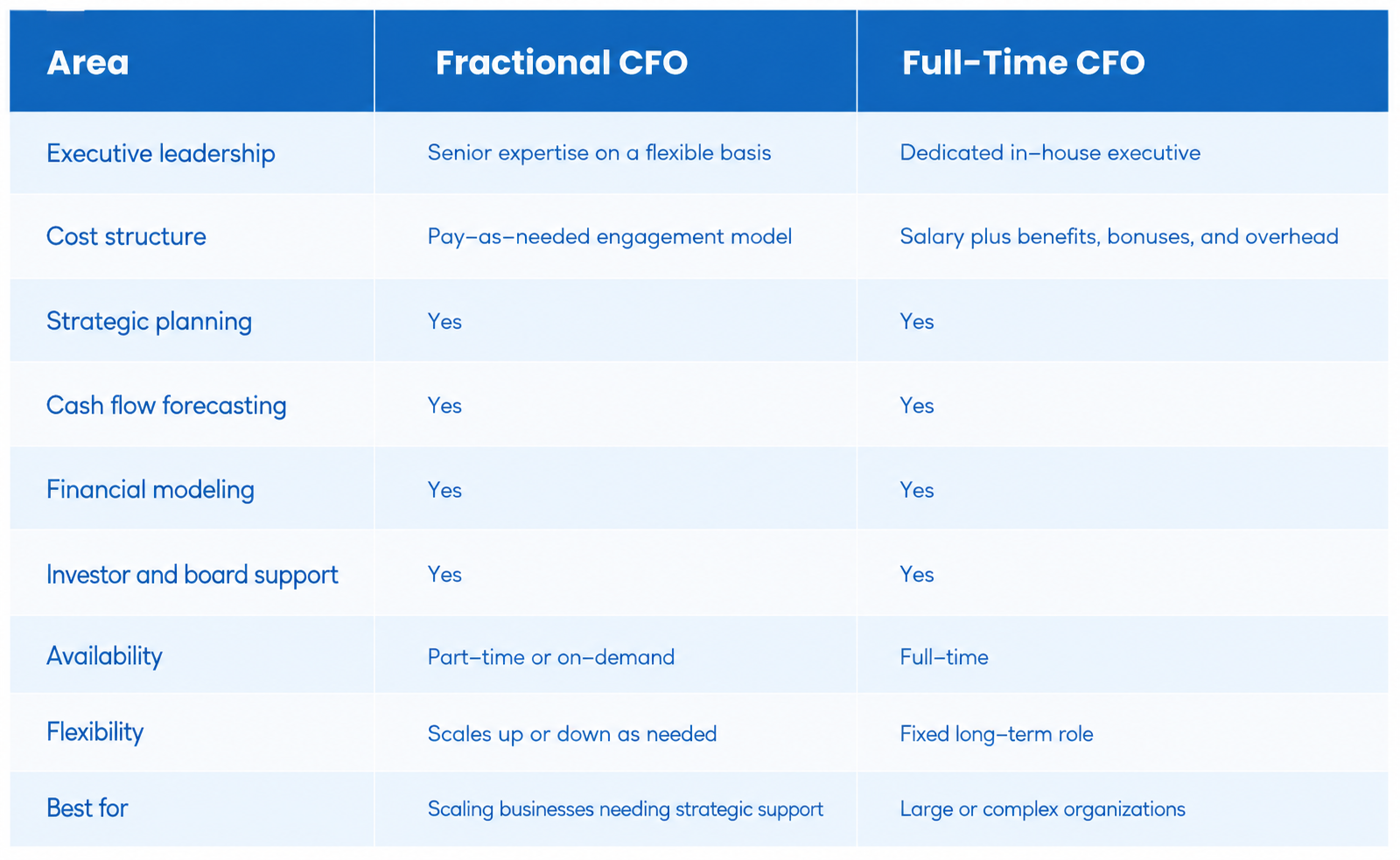
This comparison of fractional CFO vs. full-time CFO highlights an important point: both roles provide similar strategic value, but the way that value is delivered differs significantly.
Cost Comparison: Looking Beyond Salary
Cost is often the most immediate factor in the decision when comparing a fractional CFO vs full-time CFO, but it is important to understand the full financial picture before drawing conclusions.
According to Glassdoor and Salary.com, a full-time CFO in the United States typically earns between USD 160,000 and USD 280,000 annually. However, when additional costs such as benefits, bonuses, equity, payroll taxes, and recruitment expenses are included, total compensation can often exceed USD 400,000 per year.
This investment is appropriate for organizations that require constant executive oversight and fully embedded financial leadership.
However, for many growing businesses, the need for CFO-level insight is not constant. It is often periodic, intensifying during fundraising, expansion, or restructuring phases.
In this context, a fractional CFO becomes a more efficient model, offering the same expertise without the fixed overhead.
Ultimately, the decision between a fractional CFO vs full-time CFO should not be based solely on cost. It should reflect how frequently your business needs strategic financial leadership and how complex your financial environment has become.
When a Full-Time CFO Makes Sense
A full-time CFO becomes the right choice when financial leadership must be deeply embedded into daily operations and long-term governance.
This is typically true for organizations with the following characteristics:
Multiple business units or international operations
Large or complex internal finance teams
Frequent mergers, acquisitions, or restructuring activity
Strict regulatory or compliance requirements
Public company reporting obligations
Active investor or private equity involvement
Complex capital structures or debt arrangements
High governance and board reporting expectations
At this stage of maturity, financial leadership must be continuous, highly integrated, and fully aligned with operational decision-making.
It is also worth noting that many businesses do not start here. Instead, they evolve into this structure over time as complexity increases.
When a Fractional CFO Is the Better Choice
For many scaling businesses, the fractional CFO model offers a more practical and flexible approach to financial leadership. Here’s how this translates into real advantages in practice.
Access to Executive-Level Finance Leadership Early
In many cases, financial complexity emerges long before a company can justify a full-time executive. A fractional CFO bridges this gap by providing access to senior-level financial thinking earlier in the growth journey, helping businesses improve forecasting, planning, and decision-making before issues escalate.
Broader Industry Experience
Because fractional CFOs typically work across multiple companies and sectors, they bring a wider perspective to problem-solving. This exposure allows them to introduce tested strategies, benchmark insights, and practical frameworks that internal teams may not have encountered before.
Flexible Support That Aligns with Business Cycles
Financial needs are rarely static. There are periods where businesses require intensive support, such as fundraising or rapid expansion, and other periods where oversight needs are lighter. A fractional CFO adjusts to these cycles without requiring long-term fixed cost commitments.
Objective, Data-Driven Decision-Making
Another key advantage is independence. A fractional CFO provides an external, unbiased perspective on financial performance. This helps leadership teams evaluate opportunities more clearly, test scenarios more effectively, and make decisions based on data rather than assumptions.
Common Mistakes Growing Businesses Make
Despite the importance of financial leadership, many businesses delay bringing in CFO-level expertise until challenges become urgent.
To understand where things often go wrong, it is useful to look at the most common mistakes:
Hiring the Wrong Financial Role
One of the most frequent issues is confusion between financial roles. Controllers and CFOs serve very different functions. Controllers focus on accounting accuracy, reporting, and compliance, while CFOs focus on strategy, capital allocation, and forward-looking decisions.
Relying Only on Bank Balances
Another common mistake is using cash balance as the primary decision-making tool. While cash is important, it does not reflect future obligations, margins, or risk exposure. Without forecasting, businesses often make decisions that appear safe in the short term but are risky in the long term.
Delaying CFO Support Too Long
Many businesses only seek financial leadership after problems emerge. However, CFO support is most valuable when introduced early, before cash flow issues or margin pressure begin to restrict growth options.
Hiring a Full-Time CFO Too Early
Finally, some businesses commit to a full-time CFO before they truly need one. In many cases, a fractional CFO provides the same strategic value at a stage when flexibility and cost efficiency are more important than full-time oversight.
Build Financial Leadership That Scales with Your Business
At Build the Framework, we help growing businesses make smarter financial decisions through flexible, executive-level CFO support.
Our fractional CFO services are designed to give founders and leadership teams clarity and control over their financial performance. This includes improving cash flow visibility, strengthening forecasting and budgeting processes, building meaningful KPI dashboards, and supporting more confident strategic decision-making without the overhead of a full-time executive.
Our focus goes beyond reporting financial results. Instead, we connect financial data directly to business performance so leaders can understand what is driving profitability, what is constraining growth, and where to focus next.
Whether your business is preparing for expansion, raising capital, improving operational performance, or building stronger financial systems, our goal is to support sustainable and informed growth.
If you are ready to strengthen your financial leadership, schedule a free consultation to explore how Build the Framework can support your business with fractional CFO services.
