
Fractional COO vs. Full-Time COO: Cost, Flexibility, and Strategic Impact
As businesses grow, operational complexity often increases faster than revenue. New hires, expanding service lines, multiple locations, evolving technology, and higher customer expectations all place greater demands on leadership. What once worked through founder oversight and informal processes begins to break down as the business scales. This is where operational leadership becomes critical.
A Chief Operating Officer (COO) provides the structure, systems, and execution discipline needed to translate strategy into consistent business performance. They oversee day-to-day operations, improve efficiency, align teams, and ensure the business can scale without creating unnecessary complexity.
For many growing companies, however, the question isn't whether they need operational leadership. It's whether they need a full-time COO or a fractional COO.
The answer depends on your business's stage of growth, operational complexity, and how much executive capacity you actually require. While larger organizations often benefit from a dedicated in-house executive, many scaling businesses can achieve similar strategic outcomes through a fractional COO at a significantly lower cost.
In this article, we'll compare fractional COO vs. full-time COO, examine the cost, flexibility, and strategic impact of each model, and help you determine which approach best supports sustainable growth.

Why Operational Leadership Becomes Essential as Businesses Grow
Most businesses don't struggle to grow because they lack demand. They struggle because their operations can't keep pace with growth.
During the early stages, founders naturally manage most operational decisions themselves. They oversee projects, hire employees, solve customer issues, improve processes, and coordinate departments. While this approach works initially, it becomes increasingly difficult as the organization expands.
Growth introduces new operational challenges:
Larger teams requiring stronger leadership
More complex workflows and service delivery
Cross-functional coordination between departments
Increased customer expectations
Greater operational risk
Higher overhead and resource allocation decisions
Without an operational structure, businesses often experience inconsistent execution, communication breakdowns, declining productivity, and founder burnout.
Research fromMcKinsey & Company consistently shows that organizations with strong operational excellence outperform competitors in productivity, profitability, and long-term growth. The ability to execute strategy consistently is often a greater competitive advantage than strategy itself. This is precisely where a COO creates value.
What Does a COO Actually Do?
Before comparing the two models, it's important to understand what a Chief Operating Officer is responsible for.
A COO focuses on execution. While CEOs typically concentrate on vision, growth opportunities, and external relationships, COOs ensure the business has the operational capabilities to achieve those objectives.
Typical COO responsibilities include:
Operational strategy and execution
Business process improvement
Workflow optimization
Team leadership and accountability
Resource planning
KPI development and performance management
Cross-functional collaboration
Capacity planning
Organizational scaling
Change management
Operational risk management
Technology and systems implementation
Rather than simply keeping the business running, an effective COO builds systems that allow the organization to operate more efficiently as it grows. Their role is to eliminate bottlenecks, improve consistency, and ensure operations support long-term strategic objectives.
To explore the role of a Fractional COO in helping businesses scale effectively, read our article on What Does a Fractional COO Actually Do for a Scaling Business? Roles and Responsibilities Explained.
Fractional COO vs. Full-Time COO: What's the Difference?
The primary difference between a fractional COO and a full-time COO is not expertise; it's executive capacity.
A full-time COO becomes a permanent member of the executive leadership team, overseeing daily operations and participating in virtually every major operational decision.
A fractional COO, by contrast, provides executive-level operational leadership on a flexible basis. Businesses engage them for a defined number of days each month or during periods of significant operational change, such as rapid growth, restructuring, systems implementation, or organizational transformation.
Both roles focus on improving operations, strengthening execution, and supporting business growth. The difference lies in how much leadership the business actually needs.
For many companies, strategic operational guidance several days each month delivers significantly more value than hiring a permanent executive before operational complexity justifies the investment.
Fractional COO vs. Full-Time COO: Side-by-Side Comparison
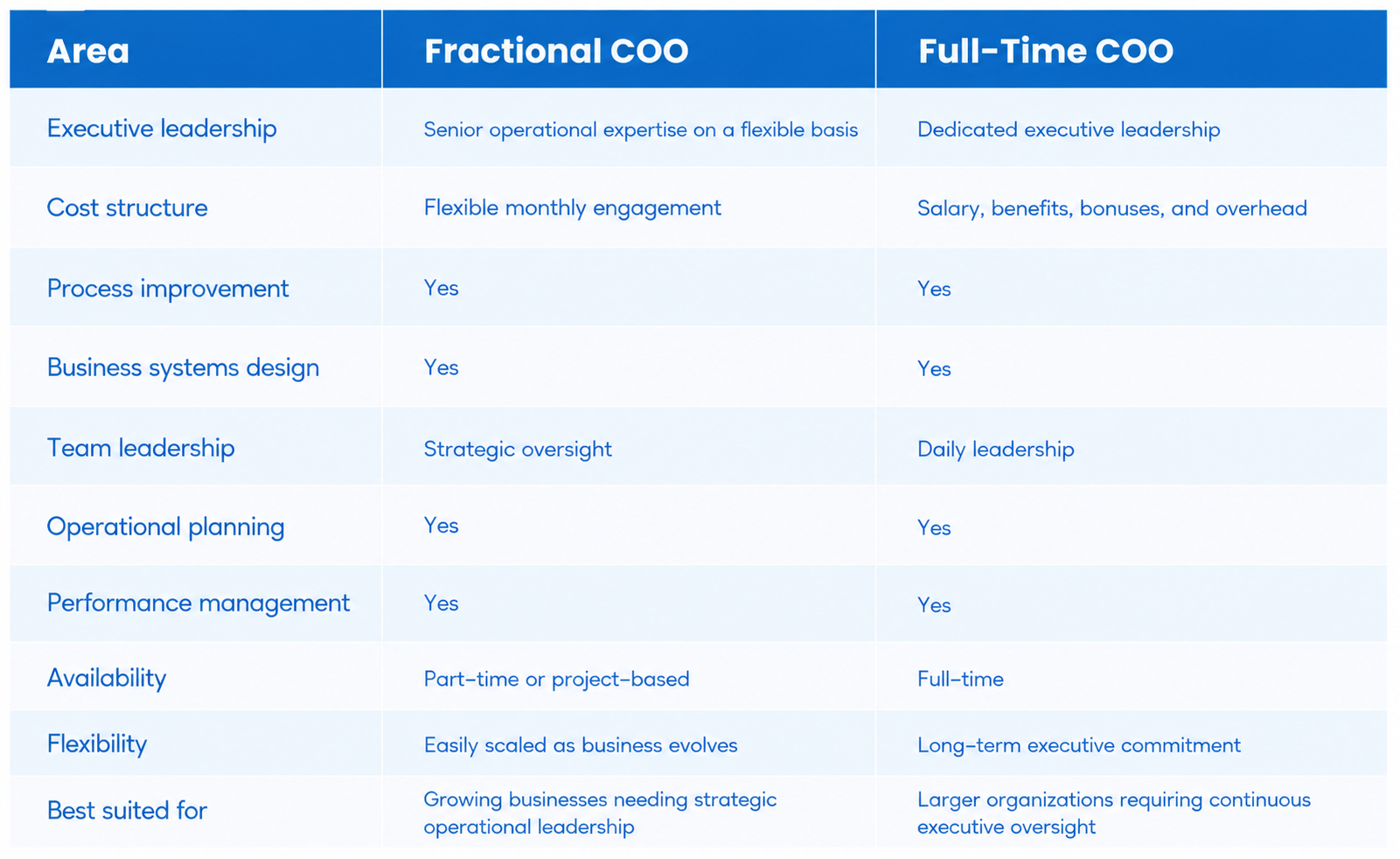
The comparison illustrates an important point. The capabilities of both models are remarkably similar. The real distinction is the amount of operational leadership required on an ongoing basis.
Cost Comparison: Looking Beyond Salary
Cost is often one of the first considerations when evaluating a fractional COO vs. a full-time COO, but salary alone doesn't tell the whole story.
According to compensation data from Glassdoor and Salary.com, experienced Chief Operating Officers commonly earn annual base salaries ranging from approximately USD 140,000 to well over USD 250,000, depending on company size and industry. Once bonuses, healthcare, payroll taxes, retirement contributions, equity incentives, and recruitment expenses are included, total compensation can exceed USD 350,000 annually.
For organizations requiring executive operational leadership every day, this investment often makes sense. However, many growing businesses don't yet require forty or fifty hours of COO involvement every week.
A fractional COO allows companies to access executive-level operational expertise based on actual business needs. Whether the engagement involves one day per week, several days each month, or focused support during a growth initiative, businesses receive experienced leadership without carrying permanent executive overhead. This enables organizations to invest in operational excellence while preserving capital for hiring, technology, marketing, or expansion.
Ultimately, the smartest decision isn't the cheapest one. It's the one that aligns leadership resources with the current complexity of the business.
Strategic Advantages of a Fractional COO
For many growing businesses, the value of a fractional COO extends well beyond cost savings.
Access Executive Leadership Earlier
Many founders delay hiring operational leadership because they believe a COO is only appropriate for much larger organizations.
In reality, operational complexity often appears long before revenue justifies a full-time executive. A fractional COO allows businesses to strengthen systems, improve accountability, and establish scalable operational foundations before inefficiencies begin limiting growth.
Stronger Business Systems
One of the most valuable contributions a fractional COO makes is designing systems that reduce reliance on individual effort.
This includes:
Standard operating procedures
Process documentation
Workflow optimization
Capacity planning
Performance dashboards
Accountability frameworks
Rather than solving the same operational problems repeatedly, leadership builds repeatable systems that improve consistency across the organization.
Cross-Industry Perspective
Fractional COOs frequently work across multiple industries and business models. This experience enables them to identify operational bottlenecks quickly, introduce proven frameworks, and recommend best practices that internal teams may never have encountered.
Their external perspective often accelerates operational improvement while avoiding common scaling mistakes.
Greater Organizational Agility
Business needs evolve constantly. Operational leadership requirements increase during expansion, acquisitions, technology implementation, hiring initiatives, or organizational restructuring.
The fractional model allows executive involvement to scale alongside these changing needs without restructuring executive leadership every time priorities shift.
When a Full-Time COO Makes More Sense
Although fractional COO services provide significant value for many growing businesses, they aren't the ideal solution for every organization. A full-time COO becomes increasingly appropriate when operational leadership is required every day.
This often applies to businesses with:
Multiple operating divisions
Several physical locations
Hundreds of employees
Large middle-management structures
Complex manufacturing or logistics operations
International operations
Continuous organizational transformation
Extensive regulatory oversight
In these environments, operational leadership extends beyond strategic guidance into continuous organizational management. The COO works daily with department heads, manages executive priorities, oversees operational performance, and ensures alignment across the entire organization.
Many businesses naturally progress toward this stage over time. In fact, it is common for companies to begin with a fractional COO before transitioning to a permanent executive as operational demands continue to grow.
Common Mistakes Growing Businesses Make
Operational challenges rarely appear overnight. More often, they develop gradually as growth exposes weaknesses in existing systems.
Some of the most common mistakes include:
Waiting Too Long to Improve Operations
Many businesses only invest in operational leadership after experiencing declining customer satisfaction, delivery delays, employee turnover, or founder burnout. Strong operations should be built before growth exposes weaknesses.
Confusing Activity with Productivity
Teams can remain extremely busy while overall business performance stagnates. A COO focuses on improving operational efficiency, not simply increasing activity.
Relying Too Heavily on the Founder
When every important decision flows through the owner, growth eventually slows. A COO builds systems and accountability that allow leadership responsibilities to be distributed effectively.
Scaling Without Standardized Processes
Hiring additional employees doesn't automatically improve performance. Without documented systems and repeatable workflows, complexity often increases faster than capacity.
Build Operational Systems That Scale with Your Business
At Build the Framework, we help growing businesses build the operational foundations needed for sustainable growth.
Our consulting services focus on improving business systems, streamlining workflows, strengthening operational performance, and reducing founder dependency. We work alongside leadership teams to identify bottlenecks, improve accountability, optimize processes, and build scalable operating models that support long-term success.
Rather than simply improving individual processes, we design systems that connect strategy, operations, people, and performance. The result is a business that operates more efficiently, scales more confidently, and delivers consistent results as it grows.
Whether you're preparing for expansion, improving operational efficiency, or building stronger leadership systems, we provide practical guidance tailored to your stage of growth.
If your business is ready to move beyond reactive decision-making and build a stronger operational foundation for growth, schedule a free consultation with Build the Framework.
